





Most conversations about AI begin with the technology. The more productive ones begin with a job that nobody in the business enjoys doing.
Key takeaways
- Choose a first AI use-case the business already feels as a problem, rather than the idea that shows the technology off best.
- Apply the six-month test: if AI took the administrative weight off one team for six months, would you genuinely notice?
- Keep the first use-case bounded to a single team, so ownership, measurement and accountability are obvious from day one.
- Measure from inside the process once it is running, because this kind of value is observed rather than forecast.
- Begin before your data is tidy, because waiting for perfect data stalls more programmes than almost any other belief.
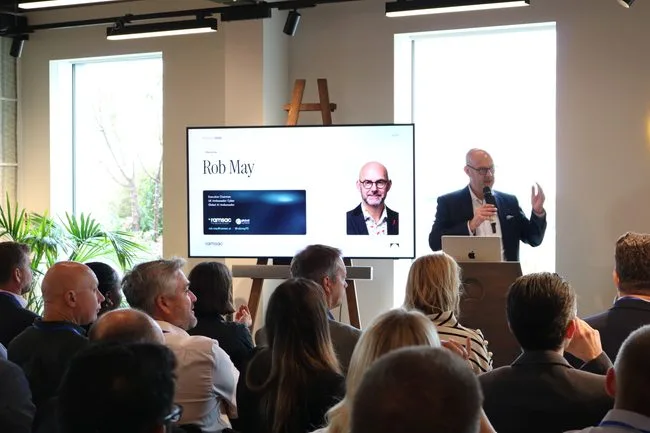
At the first ramsac AI Summit in September 2026, the closing message to a room of business leaders was a single instruction: find your flagship use-case. It is deliberately narrow advice. The question leaders arrive with is usually much broader, something closer to “what should we be doing about AI”, and that question has no good answer because it has no edges. The narrower version does.
Start with a problem the business already feels
The strongest AI projects tend to begin with something that was already a problem before anyone mentioned AI. A team that spends its mornings sorting a shared inbox. A finance function that rekeys the same information into three systems. A support desk where the first twenty minutes of every request is working out what the request actually is.
These are unglamorous, and that is rather the point. The alternative pattern is familiar to anyone who has watched a technology programme stall: a capability goes looking for a problem, produces something that demonstrates well in a meeting, and then quietly goes unused, because nobody in the business was waiting for it. Starting from a problem people already feel means somebody is waiting for it, which turns out to matter more than the sophistication of what you build.
There is a second advantage. A problem the organisation already recognises comes with a shared, pre-existing sense of how bad it is. That gives you something honest to compare against later, which is much harder to construct after the fact.
The six-month test
One test cuts through most of the internal debate. Pick a team. Imagine that for the next six months, the administrative weight of that team’s work was substantially lighter: the sorting, the chasing, the rekeying, the first draft of everything. Would the business genuinely feel the difference?
For most candidate ideas, the honest answer is no. It would be interesting, it would look good in a board update, and nothing downstream would change. For one or two, the answer is obviously yes, and people can usually tell you precisely what they would do with the time. That is your flagship.
Note what the test does not ask. It does not ask which idea is most ambitious, which uses the most capable model, or which would impress a customer. Those questions produce a different shortlist, and typically a worse one.

What a flagship use-case looks like in practice
The useful shift of the last couple of years is that AI has moved from answering questions to doing work. A tool that answers faster saves an individual a few minutes. Something that takes a step of the process off a team changes the shape of the process itself. In practice, strong first use-cases tend to take one of three shapes:
- Triaging what arrives. Classifying, routing and summarising incoming requests, so that the person who picks one up starts with context rather than with a puzzle.
- Drafting the first version. Producing the initial response, report or summary for a human to check and send, which moves the effort from creation to review.
- Finding the patterns. Noticing the trend across a body of work that nobody has time to read end to end, and raising it before anyone thinks to ask.
None of these removes the judgement from the job. Each removes a layer of preparation that sits in front of the judgement, which is usually where the hours go.
What to measure, and where to measure it from
This is the part most business cases get backwards. Value of this kind is observed once something is running properly, not calculated in advance from a spreadsheet. That is uncomfortable for anyone who needs a complete financial case before approving a start, and it is still true.
It does not mean abandoning measurement. It means measuring from inside the process rather than demanding proof from outside it. Before you begin, write down two or three things you can count today: how long the task takes, how many items arrive, how many get handled the same day. After a month of real use, count them again. That comparison will tell you more than any projection would have.
It also helps to be clear about what you are not measuring. Time saved is rarely banked as a cost reduction, and presenting it that way tends to make people defensive about their own roles. The honest framing is what the time gets spent on instead: the customer, the craft, the work that needed a person’s attention and was not getting it.
One belief to set aside early is that the data must be fixed first. You do not need to reorganise every system before you can start. A single well-understood process with reasonably reliable information in it is enough to learn from, and the learning usually tells you which data problems are genuinely worth solving.
Common questions
How big should our first AI use-case be?
Small enough that one team owns it and large enough that the team would notice if it stopped. Bounding it to a single team makes accountability obvious and keeps the measurement clean. Organisation-wide programmes are much harder to attribute and much slower to prove.
Do we need to fix our data before we start?
No. Waiting for perfect data is one of the most common reasons AI programmes never begin. Choose a process where the information is reasonably reliable and well understood, start there, and let what you learn tell you which data problems are worth the investment.
How do we know whether it worked?
Take a simple baseline before you start, such as how long the task takes and how much of it gets cleared each day, then measure the same things after a month of genuine use. Judge it from inside the process, not from a forecast made before anything was running.
Choosing yours
The organisations making progress with AI are rarely the ones with the most sophisticated strategy document. They are the ones that picked something real, bounded it sensibly, and started building working habits around it while others were still deciding. Nobody is ahead, which means the question is not whether you have missed the moment. It is which single problem you are going to take seriously first.
If you would like help identifying yours, our AI readiness assessment gives a clear view of where your organisation stands today and what a sensible first use-case might look like, including the governance and data questions worth settling before you begin. It sits alongside the wider AI transformation and strategy work we do, and where the answer turns out to be a capability already sitting in your existing licences, such as Microsoft Copilot, we will tell you that rather than build something new.
Book an AI readiness assessment with ramsac to identify your flagship use-case and the first six months of work behind it.
AI Readiness Assessment
Book your AI Readiness Assessment with ramsac
We’ll help you uncover the most valuable opportunities for AI in your business and provide straightforward guidance on how to implement it safely, effectively and with confidence.