





Refusing to put client information near AI sounds like diligence. Often it isn’t a decision at all, just a default nobody has questioned.
Key takeaways
- Whether AI can be trusted depends largely on choices you control, such as where a system runs and who can reach it.
- Allocate a risk budget so caution is spent where sensitivity is genuinely high, instead of applying one blanket rule across everything.
- Answer the same four questions you have already answered for every other system: where it runs, who can access it, whether it is encrypted, and whether it is auditable.
- Map types of information against what AI is allowed to do with them, because reading and summarising carries a different risk from acting without review.
- Expect the exercise to expose gaps in systems that predate AI, which is an argument for starting rather than waiting.
At the first ramsac AI Summit in September 2026, the session on trust drew on five years of privacy and trust work at a global technology platform scrutinised by regulators on most continents. Its most useful idea was a simple way of deciding where to ‘spend your caution’.
The objection that sounds most like diligence
Of all the reasons organisations give for not adopting AI, the data objection is the one nobody wants to be seen dismissing. It sounds responsible, and it often is. But it’s also the objection most likely to be covering for a missing decision. Nobody has said what would need to be true for the answer to be yes, so the answer stays no.
An organisation that says it does not trust AI with client data has usually not specified which data, held where, accessible by whom, doing what. Without those specifics the position cannot be tested, so it never changes. Meanwhile the same organisation is placing client information into a cloud productivity suite, a practice management system and an email platform, and each of those went through exactly this kind of assessment before it was approved.
The more useful step is to make the objection precise enough to answer.
What a risk budget is
You have a finite amount of caution, scrutiny and process to spend. Spending it evenly across everything is not prudence, it is waste, and it produces the familiar outcome where a low-risk experiment waits three months for the same review that a client-data integration gets.
A risk budget allocates that scrutiny deliberately. Low-sensitivity work in low-consequence processes gets a light touch and moves quickly, while high-sensitivity work in consequential processes gets the full weight of review and is worth slowing down for. The judgement is not whether to be careful, but where being careful actually buys you something.
Rob May, Executive Chairman at ramsac, summed up the same principle on stage: govern what matters without slowing what works. Good governance is judgement applied where risk and sensitivity are genuinely high. A brake applied evenly across everything is not governance, it is friction. Organisations that cannot distinguish the two end up with both a slow business and an unexamined risk somewhere they were not looking.

Four questions you have already answered
For every system that touches sensitive information, your organisation has already answered four questions.
- Where does it run, and in which jurisdiction?
- Who can access what is in it, and how is that access granted and removed?
- Is the information encrypted in transit and at rest?
- Can you tell afterwards who did what with it?
AI tools need the same four answers, but the questions rarely get asked. The reason is usually that the tool arrived as a feature inside something already approved rather than as a procurement, so it never passed the desk where those questions get asked. That’s a gap in process rather than a risk in the technology, and closing it mostly means making sure new AI features go through the same review as new software.
If a tool can’t give good answers, that doesn’t have to mean a blanket ban; it means limiting what it’s used for. A tool that cannot tell you who accessed what does not get client data. It might still be perfectly appropriate for drafting internal documents, and refusing it entirely costs you something for no additional safety.
How AI tightens governance rather than only threatening it
At the Summit, the discussion took a more optimistic turn when the question was turned around: what if AI makes governance better rather than worse?
Introducing AI forces a business to ask where its data actually lives, who can reach it and what is being done with it. Most organisations find that these questions have uncomfortable answers, and that the uncomfortable answers predate AI by years: the shared drive nobody has audited, the folder inherited from a departed colleague, the system where access was granted on joining and never reviewed.
That discovery is often treated as a reason to stop, when it’s really a reason to start. The exposure was already there, silently, and the only new thing is that somebody finally looked. Organisations that use the AI conversation as the prompt to do the access review they had been deferring tend to end up materially better governed than they were, regardless of what they subsequently deploy.
For organisations in regulated sectors, this is worth raising early with whoever owns the compliance relationship. The Information Commissioner’s Office (ICO) expectations around personal data apply to processing by these systems as they do to any other, and a documented risk budget is considerably easier to explain to a regulator than a blanket policy that the business has been quietly working around.
Common questions
Is it safe to use AI with client data?
It can be, depending on choices you control rather than on the technology itself: where the system runs, who can access it, whether information is encrypted, and whether activity is auditable. Answer those four questions for the specific tool and the specific data, and the decision becomes testable instead of permanent.
What is an AI risk budget?
A way of allocating scrutiny deliberately, so that caution is spent where sensitivity and consequence are genuinely high, rather than applying the same review evenly to everything.
Do we need a separate AI policy, or does our existing security policy cover it?
Usually you can build on your existing policy rather than start again, but you’ll need to add specifics about which AI tools staff may use and what they can put into them. The gap is usually that AI features arrive inside software already approved, so they never pass the review point where those questions get asked.
Writing your first risk budget
Start with a single sheet. Down one side, three classes of information: public, internal, and client or personal. Across the top, three things a system might do: read and summarise, draft something for a person to check and send, or act without review. Fill in the nine boxes with what your organisation would actually permit today.
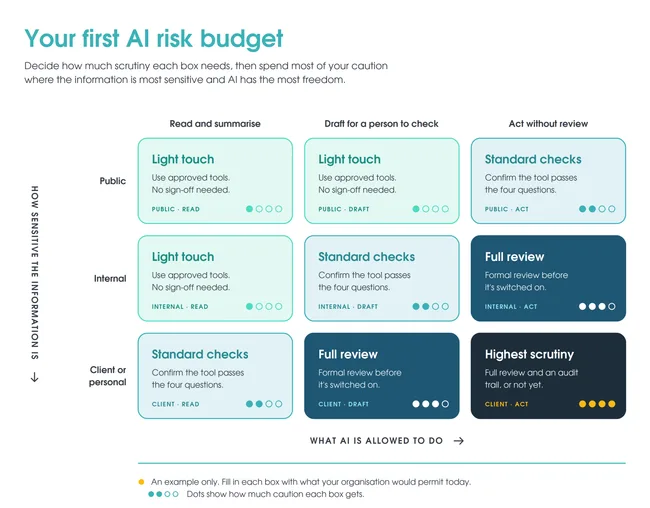
Doing this usually has two effects. First, the conversation gets concrete very quickly, because people can argue about a specific box in a way they can’t argue about AI in general. Second, people realise that nobody ever filled in a grid like this for the systems they already use, which is the more valuable finding of the two.
For organisations building this properly, our best practices for your AI governance framework sets out the wider framework this fits into, and the access and identity work underneath it is part of our managed cybersecurity services. Where the grid raises questions about where your data actually sits, our AI readiness assessment hows where your data is held and who can reach it, and gives you a proportionate first risk budget to work from.
Book an AI readiness assessment with ramsac to map what your data would allow, and where your caution is currently being spent for no return.
AI Readiness Assessment
Book your AI Readiness Assessment with ramsac
We’ll help you uncover the most valuable opportunities for AI in your business and provide straightforward guidance on how to implement it safely, effectively and with confidence.