





I was thinking recently about Sky TV.
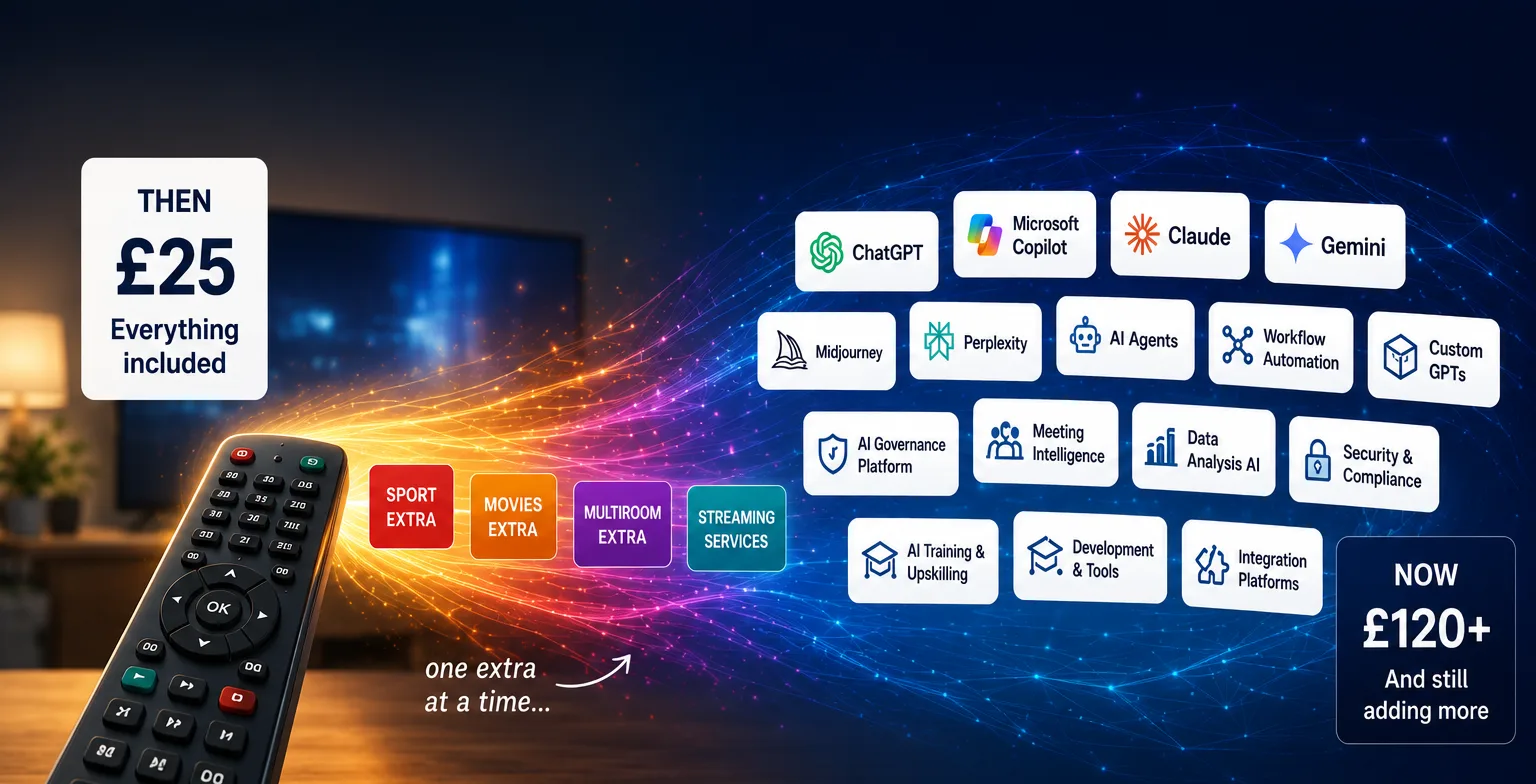
When I first subscribed, I remember paying circa £25 a month, and for that, I got everything. Every channel I wanted, every feature, and no real decisions to make.
Fast forward a few years and the landscape looks very different. Sport is extra. Movies are extra. Multiroom is extra. Streaming services have been added. Before long, what started as a relatively modest monthly subscription has become a significant household expense. For many people their Sky bill now easily exceeds £120 a month.
Nobody set out to spend that amount. It happened gradually, one seemingly sensible decision at a time and as I look at the AI market, I can’t help wondering whether we’re heading down exactly the same path.
The Sky TV-isation of AI!
AI often starts as a small IT expense
Many organisations still think about AI as an IT expense. A few licences are purchased, usually as part of a technology budget, and everyone gets excited about the possibilities. The costs initially seem modest and the barriers to entry are incredibly low.
After all, what’s £20 or £30 per user per month when compared to the cost of an employee?
But that thinking misses something important.
AI isn’t really an IT cost.
It’s an organisational capability.
And like any capability that has the potential to transform productivity, customer experience, innovation and competitive advantage, it deserves its own strategic investment plan.
This is why every organisation should consider creating a dedicated AI budget, rather than allowing AI spending to emerge across multiple technology budgets.
Why AI spending rarely stays in one department
Once an organisation starts seeing value from AI, the demand rarely stays confined to one team. Marketing wants specialist tools for content creation and campaign planning. Sales wants meeting intelligence and proposal generation. HR wants support with recruitment, onboarding and learning. Finance starts exploring analysis and forecasting. Technical teams want coding assistants and development tools.
At the same time, leaders begin looking at AI agents, workflow automation, custom GPTs, governance platforms and compliance tools. Before long, AI spending is appearing across almost every department.
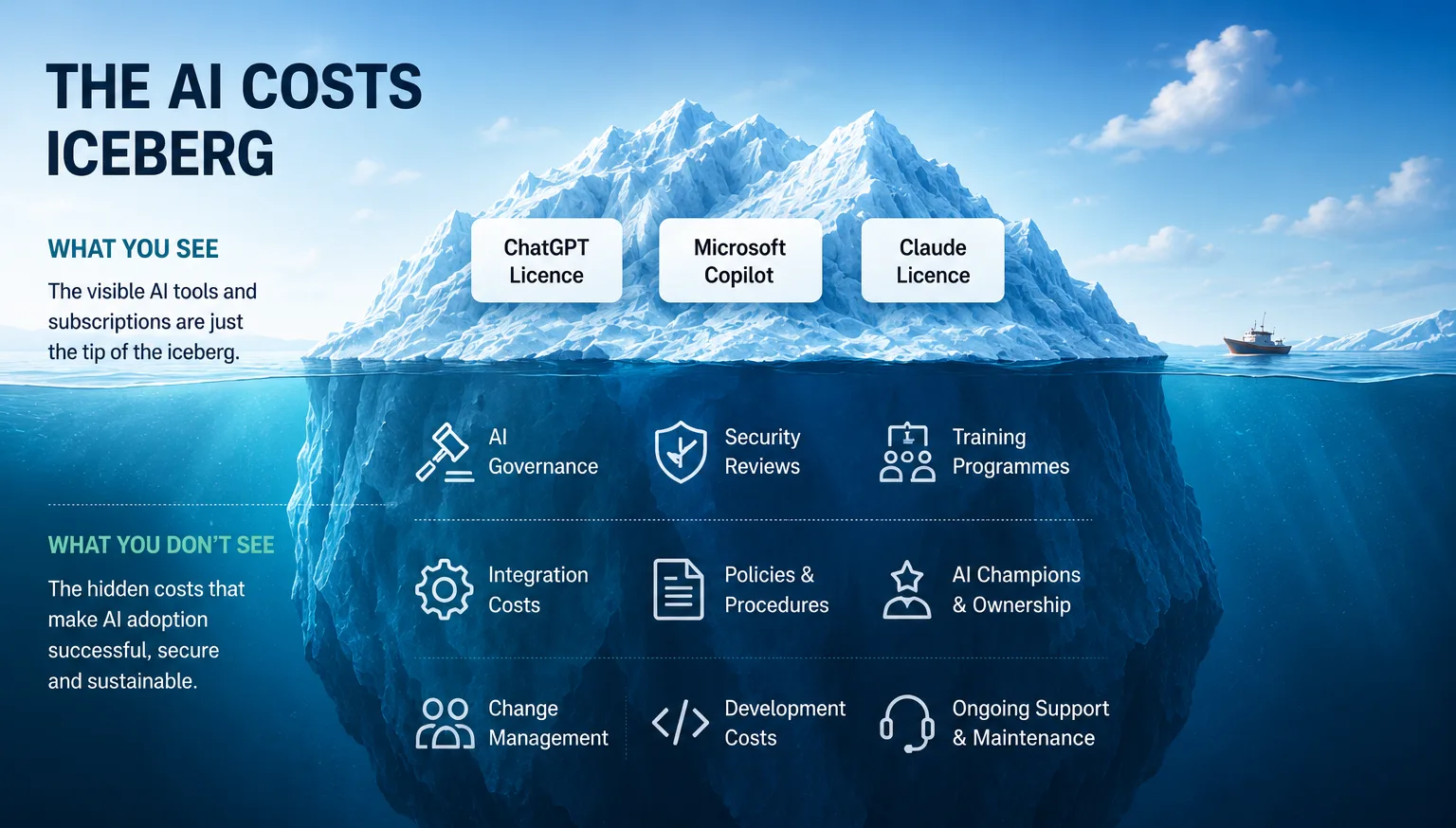
The hidden costs that make an AI budget essential
Then comes the next phase. The organisation decides it doesn’t just want to consume AI, it wants to build with it.
Now there are development costs. Integration costs. Security reviews. Governance frameworks. Training programmes. Policy development. Change management. Ongoing support and maintenance.
The conversation has moved a long way from a handful of subscriptions.
Yet when I ask leadership teams whether they have an AI budget, the answer is often no.
They have an IT budget.
They have software budgets.
They have departmental budgets.
What they often lack is a clear view of what they are investing in AI as an organisation.
Not because AI is expensive, but because it is increasingly of strategic importance.
Treat AI as a business capability, not just software
Organisations that treat AI as a business capability are generally approaching it with purpose. They have objectives, ownership, governance and measures of success. They understand what they are spending and what they expect in return. They have AI Champions and someone owns it at board level.
Others are finding AI costs emerging in multiple places across the organisation without anyone really owning the bigger picture.
The irony is that most leadership teams spend considerable time discussing digital transformation, operational efficiency and future competitiveness.
AI now sits at the centre of all three, yet many businesses still don’t budget for it as a strategic capability.

Do you know what your AI budget really is?
So, here’s the question.
If I sat down with your Finance Director today and asked them,
“What’s your AI budget for the next 12 months?”
Would they be able to answer confidently?
Not your software budget.
Not your IT budget.
Not a collection of subscriptions spread across different departments.
Your AI budget.
Because whether you’ve planned for it or not, I suspect your organisation already has one.
The only question is whether you’re managing it strategically, with clear ownership, governance and expected outcomes, or discovering it one monthly subscription at a time.
If you’d like an independent conversation about what AI is really costing your organisation, where the hidden spend is emerging, and how to build an AI investment plan or AI middleware that delivers measurable business value, I’d be delighted to arrange a discussion with one of our ramsac AI Directors.
AI Budgeting
Learn how to build an AI investment plan
Whether your organisation is just beginning its AI journey or already has AI tools appearing across multiple departments, now is probably the right time to take stock. Understanding what you’re investing, who’s responsible, and what outcomes you’re expecting will help ensure AI becomes a strategic advantage, rather than just another growing monthly cost.

FAQs: AI Budget
An AI budget is a dedicated allocation for investing in artificial intelligence across the organisation. It includes software licences, training, governance, security, integrations, change management and ongoing support.
Not necessarily. While some AI tools are purchased by IT, many organisations are finding AI benefits multiple departments. A dedicated AI budget helps provide visibility, governance and accountability.
An AI investment plan should consider technology, people, governance, security, compliance, training and measurable business outcomes, rather than focusing solely on software costs.
As AI becomes embedded across the business, governance helps ensure it is used securely, responsibly and in line with organisational policies and regulatory requirements.