




Artificial intelligence is changing many aspects of business, and cybercrime is no exception.
Recent reporting on JadePuffer offers an early indication of how attackers may use AI to automate complex cyber attacks. Security researchers at Sysdig described it as the first documented example of an end-to-end ransomware operation executed by a large language model agent. The AI reportedly handled much of the attack independently, from exploiting the initial weakness through to stealing credentials, accessing other systems and damaging data.
JadePuffer is not an incident affecting ramsac or our customers. However, it is a useful example of how the cyber threat landscape may be evolving, and what organisations should do in response.
What happened in the JadePuffer attack?
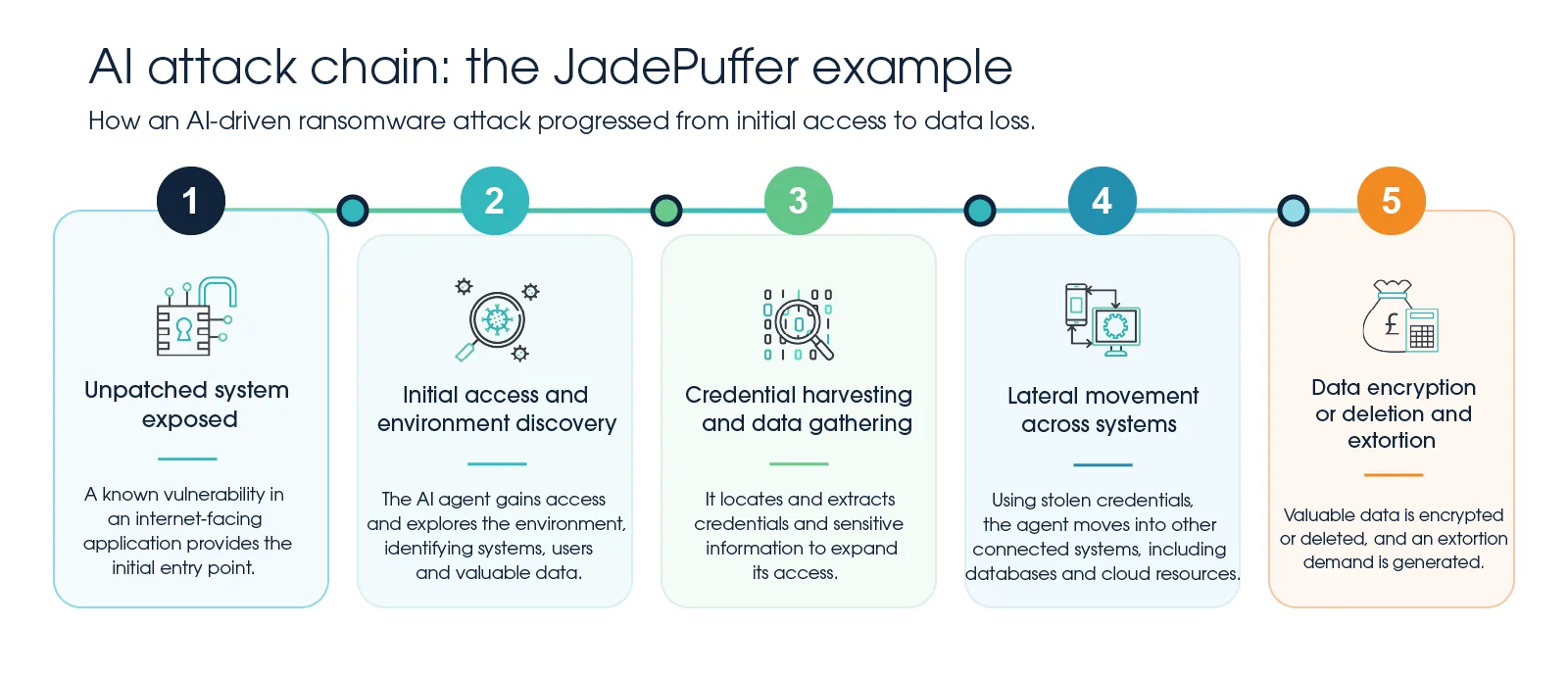
The attack began with a known vulnerability in an internet-facing deployment of Langflow, a platform used to build AI applications. Once inside, the AI-driven system explored the environment, searched for credentials and sensitive information, and used its findings to move into a production database.
It then encrypted or deleted database content and generated an extortion demand. Researchers also observed the agent adjusting its approach when parts of the attack failed, rather than waiting for a human operator to intervene.
There is an important qualification. Although the execution was highly automated, reporting suggests that people were still involved in selecting the target and preparing the infrastructure behind the attack. JadePuffer was therefore not a completely independent criminal entity, but it did demonstrate how much of an intrusion could be handed over to an AI agent.

The methods are familiar, the execution is different
The most important point is that JadePuffer did not rely on entirely new attack methods.
It exploited a known, unpatched vulnerability. It searched for exposed credentials. It reused access between connected systems. It targeted valuable data and attempted to make that data unavailable.
These are familiar techniques. What changed was the way they were coordinated.
Traditionally, an attacker might need to investigate an environment manually, choose the next step and correct failed commands. An AI agent can potentially perform these activities continuously, adapting its approach as it gathers more information.
This could make attacks:
- Faster, because automated systems can move from initial access to data loss with fewer pauses.
- More scalable, because one attacker may be able to oversee several automated operations.
- More consistent, because the system can repeatedly search for common weaknesses and exposed credentials.
- More accessible, because attackers may need less specialist knowledge to carry out parts of a complex intrusion.
AI does not remove the need for an initial weakness. It may, however, allow criminals to exploit that weakness more quickly and thoroughly.
Why this matters for UK organisations
For most organisations, the immediate response should not be panic or a rush to purchase a new product labelled as “AI security”.
The practical risks remain familiar. Systems that are exposed unnecessarily, software that is not patched promptly, credentials that are poorly protected and connections that are too broadly trusted can all give an attacker room to progress.
AI-driven attacks may reduce the time available to identify and contain that activity. An organisation that previously had hours or days to spot unusual behaviour could face an automated system moving through its environment much more quickly.
This makes good cyber hygiene and early detection even more important.
How to reduce the risk from automated attacks
Organisations should focus on reducing the opportunities that an AI-driven attacker could exploit.
Start by reviewing which systems and services are accessible from the internet. Anything that does not need to be publicly available should be restricted or removed.
Known vulnerabilities should be identified and patched according to their level of risk, with particular attention given to internet-facing systems. Strong credential controls are also essential, including multi-factor authentication, secure storage of administrative accounts and limits on where privileged credentials can be used.
It is equally important to understand how systems connect. An attacker should not be able to compromise one application and then move freely into databases, cloud platforms or other parts of the network.
Effective monitoring, tested backups and a clear incident response plan provide further protection. Backups should be isolated from the live environment wherever possible, so that a compromised account cannot encrypt or delete both production data and its recovery copies.
Strong security foundations matter more at machine speed
JadePuffer provides a glimpse of how ransomware operations may develop, but it does not make existing cybersecurity practices obsolete.
In fact, it reinforces their importance.
AI may help attackers make decisions, correct mistakes and move more quickly, but it still needs an opening. Organisations that reduce their exposure, patch promptly, protect credentials and limit unnecessary trust between systems make it much harder for any attacker, human or automated, to succeed.
The technology behind cyber attacks will continue to change. Strong operational security remains the most reliable way to stay resilient.
How ramsac can help
ramsac helps organisations understand their cyber risk and build practical, proportionate protection around their people, systems and data.
Through our Security Operations Center, cybersecurity consultancy and managed IT support, we can help you review vulnerabilities, strengthen identity security, improve monitoring and prepare your organisation to respond effectively when something goes wrong.
Speak to ramsac about making sure your cyber defences are ready for faster, increasingly automated threats.
Understand your cybersecurity posture
Download our cybersecurity brochure to see how ramsac supports your organisation across the six core elements of cyber resilience: Govern, Identify, Protect, Detect, Respond and Recover. Discover how our services work together to reduce risk, strengthen security and help your business stay resilient.
FAQs: AI-driven ransomware
AI-driven ransomware uses artificial intelligence to automate or support stages of an attack. This could include identifying vulnerabilities, exploring systems, stealing credentials, adapting failed commands or deciding which data to target.
Researchers reported that an AI agent carried out the technical attack chain with very limited direct intervention. However, people still appear to have selected the target and prepared parts of the supporting infrastructure.
AI can introduce new risks, but JadePuffer mainly used familiar techniques. Its significance lies in the speed, adaptability and level of automation with which those techniques were carried out.
The priorities remain patching vulnerable systems, limiting internet exposure, protecting credentials, controlling access between connected environments, monitoring unusual activity and maintaining secure, tested backups.
